A proposed residential treatment operation on Red Brae Drive has raised important questions about operator history, Wisconsin DHS licensing, and how the complete proposed use fits within Town of Mukwonago zoning.
In April 2026, neighbors began researching a proposed Legacy Recovery Center operation at a residential property on Red Brae Drive, including the operator's history, Wisconsin licensing requirements and Town zoning. That work grew into Concerned Families of Mukwonago and a larger community effort based on public records, direct communication with government agencies and legal guidance.
Mukwonago, Wisconsin
What initially appeared to be an eight-resident Community-Based Residential Facility (CBRF) became more complex as the services proposed for the property came into focus. Legacy is pursuing DHS 83 CBRF licensure while DHS has also confirmed Chapter 75 residential substance-use treatment certification activity. Those are distinct regulatory frameworks.
DHS's CBRF licensing review includes whether an applicant is fit and qualified. Residents submitted public records concerning prior regulatory and operational issues for DHS to consider in that review.
See the documented history →DHS 83, DHS 75.53 and DHS 75.54 regulate different things. Understanding the difference is essential to understanding the proposal.
Understand the licenses →The Town permits certain small community living arrangements in SE zoning while separately defining other health-care uses. Concerned Families has asked the Town to determine how its ordinance applies to the complete operation.
Understand the zoning question →The Community Advisory Committee was not created by Concerned Families. Wisconsin law requires a CBRF applicant to make a good-faith effort to establish a committee with representatives of the proposed facility, the neighborhood and local government before initial licensure. Its purpose is to create a forum for communication, and the committee continues after licensure to make recommendations about the facility's impact on the neighborhood.
Wis. Stat. § 50.03(4)(g) requires a CBRF applicant to make a good-faith effort to establish a community advisory committee with representation from the proposed facility, the neighborhood and local government.
At the first CAC meeting, residents heard Legacy describe therapy, psychiatric care, medication management and extensive structured therapeutic programming. On June 9, Concerned Families asked DHS whether the services described required separate Chapter 75 certification in addition to the proposed CBRF license. DHS later confirmed Chapter 75 application activity.
These are not three names for the same thing. They address different regulatory functions.
A CBRF is a residential setting for five or more unrelated adults that provides room and board, supervision and support services. DHS 83 contains the licensing rules, including the applicant's fit-and-qualified review.
Official DHS CBRF / DHS 83 page ↗Chapter 75 regulates substance-use treatment services. DHS's certification page separately lists 75.53 Transitional Residential Treatment and 75.54 Medically Monitored Residential Treatment.
Official DHS certification page ↗State licensure and local land-use regulation are different layers. On December 18, 2025, the Town approved zoning permit Z25-44 for a community living arrangement for up to eight disabled residents in the SE Suburban Estate district. The permit requires the applicant, before operation, to obtain and maintain all Wisconsin licenses required to operate a community living arrangement and provide proof of licensure to the Town. Concerned Families has asked the Town to evaluate whether the separately certified Chapter 75 treatment activities now in process change the land-use analysis.
The Town zoning framework addresses community living arrangements of eight or fewer residents. That is the land-use category associated with the proposed small CBRF.
The Town separately defines health-care uses involving medical, nursing, rehabilitative or preventative care. Concerned Families has asked whether separately certified residential treatment changes the applicable land-use analysis.
That determination belongs to Town officials. Our request is that it be made using the complete proposed service model and explained under the Town's zoning code.
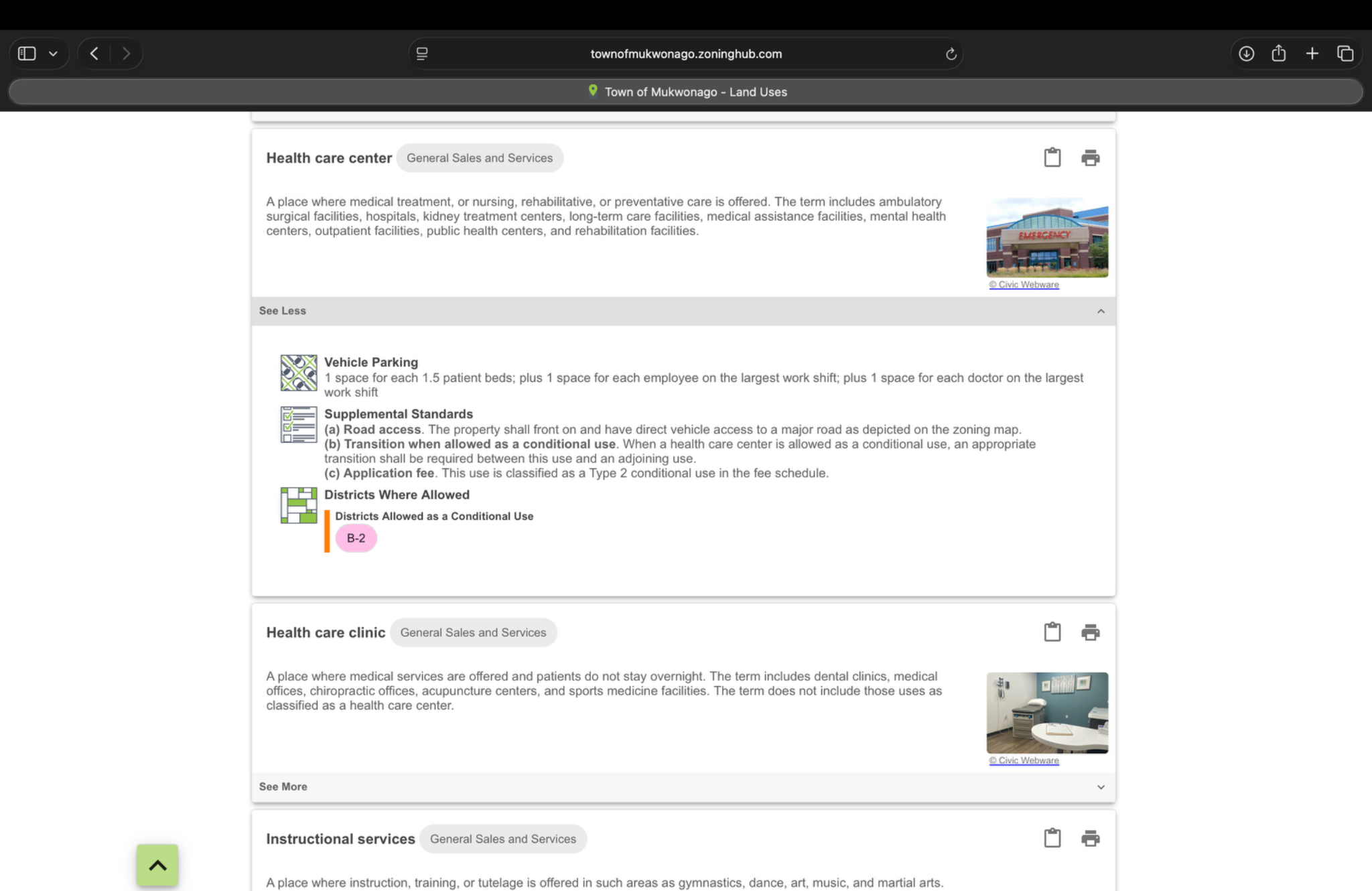
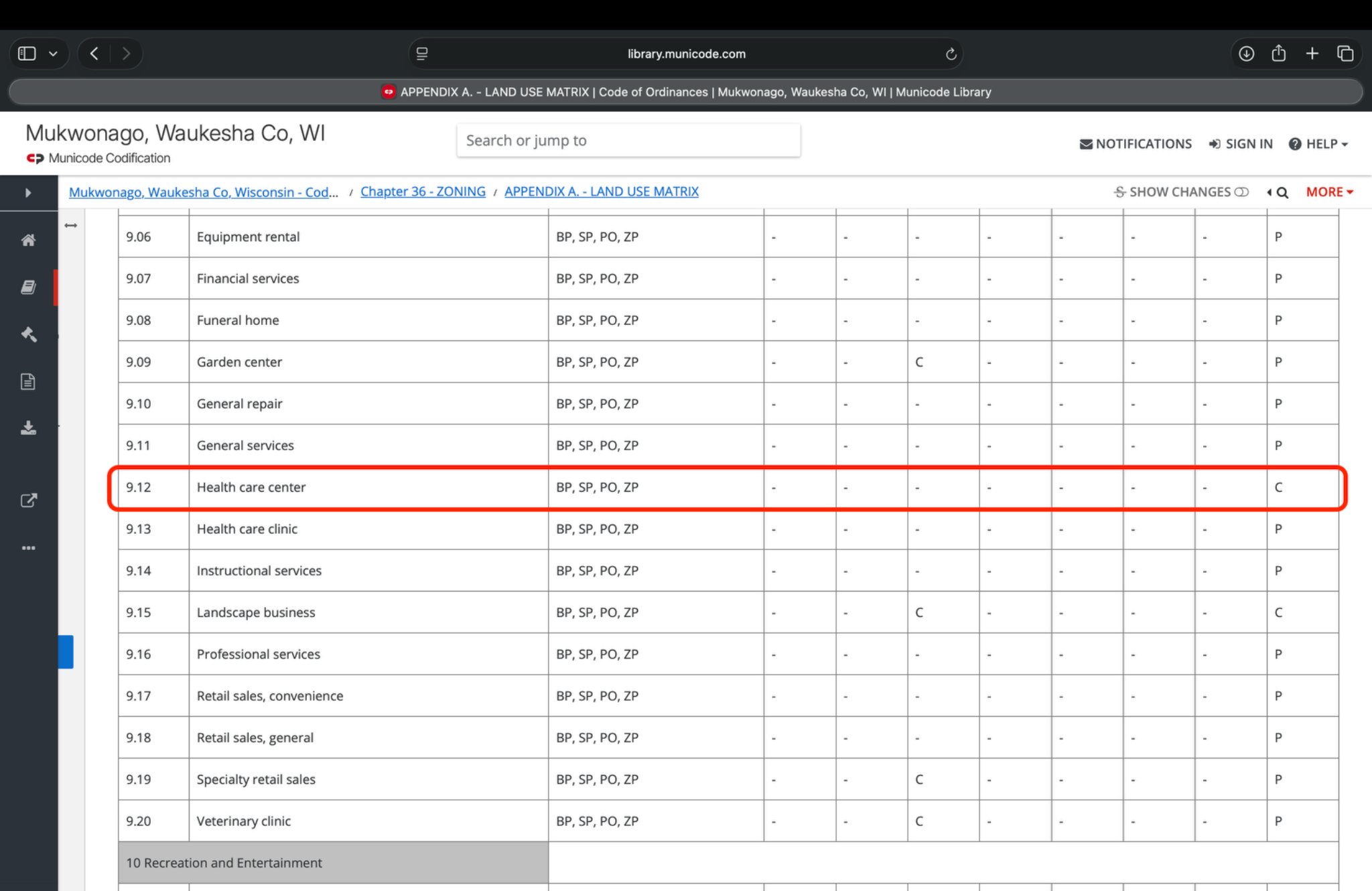
* The screenshots show the Town's published zoning classifications. Concerned Families has asked the Town to determine whether Legacy's complete proposed operation falls within the “Health care center” land-use category; this site does not make that zoning determination.
Concerned Families reviewed regulatory, municipal, law-enforcement and other records while raising these issues with Wisconsin DHS. The public index below summarizes the substantive matters identified in that research and links readers directly to supporting sources where available.
An ADHS record concerns operation of Legacy's Chandler location before the required health-care-institution license was issued, with an initial $54,000 civil penalty later reduced to $5,400.
An ADHS record required website and policy materials to be corrected to conform to the services allowed by the license.
A later ADHS matter includes $500 penalty concerning services outside licensed allowances and a prior agreement with regulators.
City of Mesa records document the City's determination that the Minton Street operation was a Transitional Community Residence requiring a Special Use Permit. City records also identify the Oct. 3, 2025 civil citation COD25-05771. Legacy disputed the City's classification and pursued an appeal.
12News reported that police encountered eight to nine residents at the Mesa home while the approval at issue was for four. This item is media reporting, not an agency adjudication.
Law-enforcement incident records identified in CFM’s research involve Legacy's Chandler location, including report numbers IR25013309, IR25015468, IR25019491, IR25027218 and IR25028962. These are incident reports, not adjudicated regulatory findings.
Records identify a police response involving a dispute between a neighbor and a resident of a recovery home.
Records identify a law-enforcement response to a resident experiencing a suicidal crisis involving a knife.
Records identify a response involving self-injury and a resident entering traffic.
Records identify a medical call during which another resident reportedly behaved aggressively toward responding officers.
Records identify a police response resulting in transport to a hospital.
Records identify a police response involving a person reportedly threatening to enter traffic.
Records identify a police report involving an intoxicated non-resident who arrived seeking admission.
MCSO records that Legacy's clinical director reported an alleged sexual assault involving two recovery clients. The report documents an allegation, not an adjudicated finding.
Records identify a report concerning a resident who left the residence and was later located.
Records identify another report concerning a resident who left the residence.
Records and news coverage identify a police/SWAT response at the Mesa facility that affected the adjacent school.
MCSO records that Legacy reported a resident missing from the Chandler property.
An MCSO report states that Legacy staff reported a client experiencing suicidal ideation and that the person was transported to Mercy Gilbert Hospital.
Records identify a police and ambulance response involving a resident outside the property.
ADHS findings under A.R.S. §36-407 and Arizona rules addressing quality management, infection control, and emergency/safety standards, including a $250 penalty for an unlicensed location.
Texas Health and Human Services correspondence reviewed by CFM states stating that its search found no license information for Synergy Mental Health or the Rockwall address identified in the submission.
An ADHS record documents a $500 matter concerning patient-record documentation.
An ADHS record documents a $500 matter concerning access to material that could cause injury. This summary reflects the submission; readers should verify the underlying ADHS record.
Arizona records document three violations and a total $11,000 penalty.
Arizona records document a $500 recordkeeping matter.
Arizona records document 13 violations and a total $15,000 penalty.
Arizona records document a matter totaling $1,250.
Arizona records document a recordkeeping matter totaling $1,000.
Arizona records document five violations and a total $4,000 penalty.
Arizona records document a $500 recordkeeping matter.
Arizona records document a $500 civil penalty concerning sufficient trained personnel.
Arizona records document a second $500 civil penalty concerning sufficient trained personnel.
Arizona records document an enforcement matter totaling $25,000 and multiple violations. This is a record involving a separate hospital with which Dr. Ehab Abdallah is associated in the records reviewed by CFM; it is not a Legacy Recovery Center violation.
An Arizona Medical Board matter reviewed by CFM concerns prescribing. The Board's own public-information system is the appropriate source for the physician record and any disciplinary documents.
CFM also reviewed recent initial-license/opening dates for organizations associated with Dr. Roland Segal and/or Dr. Ehab Abdallah. These dates are provided as context for DHS's fit-and-qualified review; growth itself is not presented as a violation.
Purpose Healing Center (Mar. 30, 2026); Ava Health Care, Colorado (Jan. 14, 2026 opening cited); Artemis Adolescent Healing Center locations (Apr. 3, Apr. 28 and Sept. 23, 2025); Icarus Wellness and Recovery (Aug. 5, 2025); Scottsdale Serenity Rehab (Apr. 9, 2025); Synergy Mental Health — Tempe (Apr. 3, 2025); Embers Outpatient (Apr. 1, 2025).
Legacy Recovery Center — Mesa (Mar. 27, 2025); Catalina Behavioral Health (Mar. 12, 2024); Synergy Mental Health — Glendale and Scottsdale (Jan. 2024 dates cited); Legacy Recovery Center — Chandler (Jan. 25, 2025); Sequoia Behavioral Health (Dec. 4, 2023).
The concerns were also brought directly to DHS by elected state legislators. Their letters are included because they show what was formally placed before the agency—not because a legislator's position decides the DHS review.
Rep. Wichgers emailed DHS with Exhibit A and asked the Department to review the application with “all due diligence.”
Sen. Bradley followed up with DHS and urged careful consideration of constituent concerns and Exhibit A.
Sen. Bradley sent a signed follow-up letter urging DHS to conduct a thorough fit-and-qualified evaluation and stating that the record warranted significant caution in evaluating the application.
Rep. Wichgers sent a signed follow-up letter to DHS again requesting careful review of the application.
Open any term for a short explanation. These definitions are intentionally plain-language summaries; the linked statutes and agency materials control.
Community-Based Residential Facility. A Wisconsin-licensed residential setting regulated under DHS 83. DHS source ↗
Transitional Residential Treatment Service: residential substance-use treatment totaling six or more treatment hours per patient per week in a structured 24-hour residential setting. DHS source ↗
Medically Monitored Residential Treatment Service: residential substance-use treatment totaling 20 or more treatment hours per patient per week in a 24-hour clinical residential setting under medical-director oversight. DHS source ↗
A licensing standard DHS applies to CBRF applicants. Compliance history—including other states' licensing history—is among the factors DHS considers.
Community Advisory Committee. Wisconsin law requires a CBRF applicant to make a good-faith effort to establish one before initial licensure as a forum among the facility, neighborhood and local government. Wis. Stat. § 50.03(4)(g) ↗
Suburban Estate zoning—the Town zoning district applicable to the Red Brae property. The Town's current Chapter 36 code and Zoning Hub are the controlling local resources. Town source ↗
A land-use concept addressed by Wisconsin law and the Town's zoning framework. Town permit Z25-44 identifies the proposed eight-resident use as a community living arrangement.
A separate land-use category in the Town zoning framework. Whether the complete Legacy proposal falls within or implicates this category is the zoning question Concerned Families has asked the Town to determine.
The Town approves an administrative zoning permit for a community living arrangement for up to eight disabled residents in the SE district. The permit requires applicable state licensure before operation.
Legacy publicly announces a behavioral-health facility in Mukwonago, describing an initial eight-bed operation.
Residents review public records, regulatory history, Wisconsin requirements and Legacy's operations elsewhere.
The group forms to provide a community voice and obtain legal consultation while continuing the records-based investigation.
Residents hear Legacy describe clinical services and treatment programming. Those descriptions lead to questions about whether Chapter 75 certification is also required.
A follow-up letter asks DHS whether the clinical services described publicly require separate behavioral-health/substance-use treatment certification.
Rep. Chuck Wichgers and Sen. Julian Bradley send multiple communications asking DHS to carefully review the application and constituent evidence. All four communications are now available in the public source library.
Legacy describes services including group therapy, individual therapy, psychiatric evaluation and medication management while licensing work continues.
The DHS 75.54 application file contains a provider agreement signed August 25. The application identifies the Red Brae address as a new facility with capacity for eight adults.
Legacy says its CBRF application has been submitted, that it passed its final fire inspection, and that it is also seeking DHS 75.54 certification. Community members continue submitting records and letters to DHS.
DHS confirms in writing that the CBRF application has been submitted and that application processes for both DHS 75.53 and DHS 75.54 have been started.
The released file identifies a new eight-person facility at Red Brae. DHS states the file is incomplete, has not been reviewed and no decision has been made.
As of October 7, 2026, this remains an active process. Application status and agency decisions can change. We will date substantive updates and distinguish confirmed agency information from positions or questions raised by Concerned Families.
Wherever possible, readers should be able to move directly from our explanation to the governing government source or the original public record.
Residents do not need to adopt Concerned Families' conclusions. We encourage everyone to read the source material and communicate their own questions or concerns directly and respectfully.
Kathleen “Kathy” Teske
Deputy Bureau Director, Bureau of Assisted Living
kathleen.teske@dhs.wisconsin.gov
608-266-0371
For comments about the pending review, identify Legacy Recovery Center and the Red Brae Drive, Mukwonago proposal so DHS can route the correspondence appropriately.
Questions, source material, or community correspondence can be sent to contact@concernedfamiliesofmukwonago.org.
Questions about SE zoning, land-use classification and the complete proposed use belong with the Town of Mukwonago. Use the Town's current public contact information so messages reach the officials serving now.
Town Board contacts ↗Concerned Families of Mukwonago is a resident-led effort. Contributions help with legal consultation, public-records costs, community communications and related expenses.
Contributions are used to support the group's community work. No representation is made that contributions are tax-deductible.
Keep it brief and factual. Identify Legacy Recovery Center, Red Brae Drive, explain your concern, reference a public record if helpful, and request a written response.
DHS — licensing & operator qualifications: ask for review of Chapters 83, 75.53 and 75.54. Email DHS ↗
Town — zoning & occupancy: ask for review of the complete proposed use under SE-1 zoning before occupancy. Town contacts ↗